
.png)

Why Government Authorities Should Adopt Recycled Plastic for Public Infrastructure

India is rapidly urbanizing, and with growing cities comes a rising demand for durable and sustainable public infrastructure. Municipal bodies and urban local bodies (ULBs) are constantly investing in public assets such as park benches, dustbins, fencing, and outdoor furniture.
However, traditional materials like wood, metal, and FRP often come with environmental costs, high maintenance, and shorter life cycles. This is where Recycled Plastic presents a powerful solution.
By converting plastic waste into long-lasting public infrastructure such as Recycled Plastic Benches and Recycled Plastic Dustbins, cities can address two major challenges simultaneously — plastic waste management and sustainable urban development.
The Growing Plastic Waste Challenge in India
India generates millions of tonnes of plastic waste every year. Despite growing awareness, a large portion of this waste still ends up in landfills, open dumping sites, or waterways. Plastic recycling in India is improving, but the country still faces a significant gap between plastic waste generation and recycling capacity.

Instead of treating plastic as waste, cities now have the opportunity to view it as a valuable raw material for infrastructure development. Recycled plastic technology allows discarded plastic packaging, bottles, and multilayer plastics to be processed and converted into durable boards and structural components. These boards can then be used to manufacture Recycled Plastic Benches, Plastic Benches for parks, outdoor furniture, and Recycled Plastic Dustbins. By integrating these recycled products into public procurement, municipalities can turn waste into long-lasting public assets.
Why Recycled Plastic Infrastructure Makes Sense for Cities
Durable and Weather Resistant
Public infrastructure faces constant exposure to sun, rain, and heavy usage. Unlike wood, Recycled Plastic benches and dustbins are resistant to moisture, termites, corrosion, and decay.
This makes them ideal for:
Parks and gardens
Bus stops
Tourist destinations
School campuses
Railway stations
Urban public spaces
Municipalities can benefit from infrastructure that lasts longer with minimal maintenance.
Low Maintenance and Long Lifecycle
Traditional wooden benches often require repainting, polishing, or replacement due to weather damage. Metal structures can rust, and FRP products may crack over time.
In contrast, Plastic Benches made from recycled plastic boards require almost no maintenance. They do not rot, splinter, or corrode, making them highly suitable for long-term outdoor use. This reduces operational costs for municipalities and helps create cost-efficient sustainable infrastructure.
Supporting Circular Economy Goals
Governments across the world are adopting circular economy frameworks that promote resource efficiency and waste reuse.
By adopting Recycled Plastic infrastructure, cities can:
Divert plastic waste from landfills
Promote responsible plastic recycling in India
Support local recycling industries
Reduce dependency on virgin materials
 |  |
This aligns strongly with national missions like:
Swachh Bharat Mission
Smart Cities Mission
Plastic Waste Management Rules
ESG and sustainability initiatives
Public procurement can become a powerful tool for accelerating the circular economy.
Visible Environmental Impact

One of the biggest advantages of recycled infrastructure is its visible environmental storytelling.
For example:
A single Recycled Plastic Bench can utilize approximately 40–50 kg of plastic waste.
When installed in public parks or institutions, it becomes a physical representation of waste being transformed into a public asset. This not only reduces waste but also creates awareness among citizens about plastic recycling and sustainable consumption.
Insights from Municipalika Expo: Conversations with Government Stakeholders
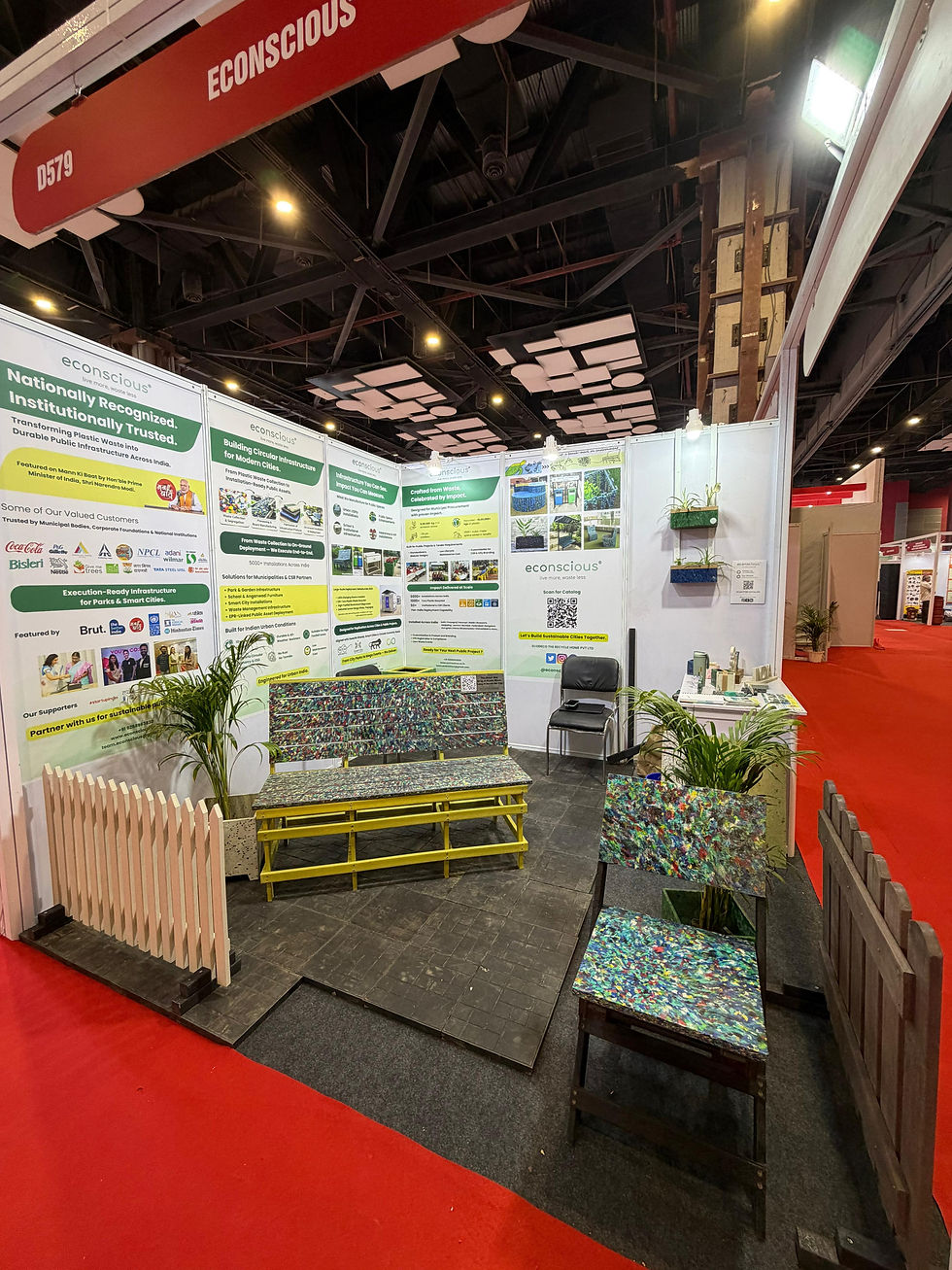
Recently, our team at econscious® participated in Municipalika Expo, one of India’s leading exhibitions focused on urban infrastructure, waste management, and smart city solutions.
During the event, we had the opportunity to interact with municipal commissioners, urban planners, sanitation officers, CSR leaders, and government stakeholders from across the country.
These discussions revealed some important insights:
Many cities are actively looking for sustainable alternatives for public infrastructure.
Municipal bodies are increasingly interested in products made from recycled materials.
There is growing awareness about Plastic recycling in India, but adoption still needs policy support and procurement encouragement.
Several stakeholders expressed interest in solutions such as:
Recycled Plastic Benches for parks and public spaces
Recycled Plastic Dustbins for waste segregation
Outdoor furniture made from recycled products
Sustainable infrastructure that supports ESG goals
The conversations reinforced the idea that public procurement policies can play a critical role in scaling recycled plastic infrastructure across cities.
The Way Forward: Integrating Recycled Products in Public Procurement
For large-scale adoption, it is important for municipalities and government authorities to actively integrate recycled products into procurement policies.
This can include:
Preference for Recycled Plastic benches and dustbins in park development projects
Mandating recycled materials in certain public infrastructure categories
Encouraging local recycling startups and manufacturers
Linking recycled infrastructure to carbon and sustainability reporting
Such steps can help cities become cleaner, more resource-efficient, and environmentally responsible.
Turning Plastic Waste into Public Value
Plastic waste is often viewed as a problem. But with the right approach, it can become a valuable resource for building cities. By adopting Recycled Plastic public infrastructure, governments can simultaneously address:
Plastic waste management
Sustainable urban development
Circular economy goals
Long-lasting public infrastructure needs
The future of cities lies in sustainable infrastructure, and recycled plastic solutions are an important step in that direction.
About ECONSCIOUS
At econscious®, we convert post-consumer plastic waste into durable Recycled Plastic benches, Recycled Plastic Dustbins, and other public infrastructure products. Our mission is to ensure that plastic waste does not end up in landfills or oceans but is transformed into meaningful, long-lasting public assets. We work with municipalities, CSR organizations, and institutions across India to create sustainable infrastructure from recycled plastic.


Comments